
Frequently Asked Questions
Myths & Misinformation
Will my decision to be a donor affect my medical care if I am injured or sick and admitted to the hospital?
No. By law, the doctors who work to save your life are not the same professionals who are involved in transplantation and organ donation. If you are sick or injured and admitted to the hospital, you will receive the same level of care regardless of whether or not you have indicated your wish to be an organ, eye and tissue donor. The doctors treating you are not involved with transplant programs or possible recipients. In addition, doctors and hospital staff do not have access to the Virginia Donor Registry. Only donor program personnel can access the Virginia Donor Registry – not the medical professionals taking care of you.
If I register to be a donor, how can I be sure that I’ll really be dead when organs and tissues are recovered?
Organ donation is only accepted following the declaration of death by a doctor who is not involved in transplantation. In order to donate organs, a patient must be declared brain dead, or in cases where a family requests withdrawal of ventilator support, declared dead by cardiac criteria. Brain death is the complete and irreversible loss of all brain function, including the brain stem and therefore, the patient has no chance of recovery.
To be a legal determination, Virginia Code requires that a licensed medical professional makes this declaration based on clinical exams and nationally accepted brain death testing methods.
The first and foremost job of healthcare professionals at any hospital is to do everything they can to try and save your life. It is only after all of these efforts have been exhausted and death has been declared that organ, tissue and eye donation would even be considered
Do famous or wealthy people get transplants quicker?
No. The organ allocation and distribution system is blind to wealth or social status. A national computerized matching system is used to place available organs with potential recipients. This current system is administered by the United Network for Organ Sharing (UNOS), located in Richmond, Virginia.
National policies govern the sharing of organs in the U.S. to ensure all patients fair and equal access to transplantation. The length of time it takes to receive a transplant is influenced by a variety of factors including location, severity of illness, physical characteristics (blood type, weight, genetic typing, and size) and length of time on the waiting list. Factors such as income or celebrity status are never considered when determining who receives an organ.
Is there a black market for organ donation? Can I get paid for my organs?
There is no evidence of such activity ever occurring in the United States. According to the National Organ Transplant Act of 1984, it is illegal to buy or sell human organs in the U.S. Violators are subject to fines and imprisonment. In addition, a national governing body reviews every organ donation and transplant. Strict regulations prevent any type of “black market” existence in the United States, and the World Health Organization, among others, has strongly condemned such practices abroad.
Are TV and movie stories about donation true?
In general, the TV and movie industry sensationalize and distort information about donation and transplantation. Remember these mediums are designed to entertain audiences and are not the best way to learn the facts about any particular subject.
Is donation against my religion?
All major religions support organ, eye and tissue donation and consider donation the greatest gift one can give. Transplantation is consistent with the life preserving traditions of these faiths. The donation of life is an act of human kindness in keeping with religious teachings.
Am I too old or unhealthy to donate?
No. Anyone can be considered for donation. Many people erroneously believe they cannot donate due to a past medical history or age. At the time of death, donation program professionals will review your medical and behavioral history to determine if you are a candidate for donation. There is such a critical need for organs currently in the U.S., the criteria for donation are changing constantly. In most cases, anyone can be a donor. To date, the oldest donor was 101 years old.
About Donation
What is organ, eye and tissue donation?
Organ, eye and tissue donation is the process of recovering organs, eyes, and tissues from a deceased person and transplanting them into others in order to save the lives or improve the health of those in need. Up to eight lives can be saved through organ donation, and another 75 lives or more may be improved through tissue donation.
What organs and tissues may be donated?
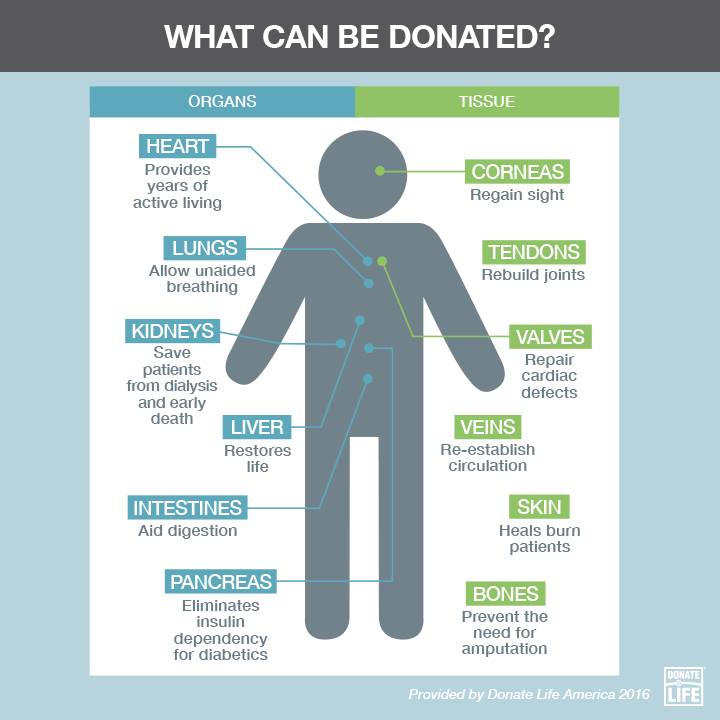
The most commonly transplanted organs are the kidneys, liver, heart, and lungs. In recent years, success has been achieved in curing diabetes with a pancreas transplant or extracting and transplanting islet cells from the pancreas that produce insulin.
Although only a small number of intestinal transplants have been performed, this treatment holds great hope for patients whose intestines have been severely damaged through illness, trauma or birth defects. Sometimes the stomach is also recovered and transplanted at the same time. Commonly recovered and transplanted tissues enhance the lives of many who suffer from traumatic injury or disease:
- Skin is used as a temporary dressing for burns, serious abrasions and other exposed areas.
- Bone is used in orthopedic surgery to facilitate healing of fractures or to prevent amputation.
- Heart valves are used to replace defective valves, often in children.
- Tendons are used to repair torn ligaments on knees or other joints.
- Veins are used in cardiac bypass surgery.
- Corneas can restore sight to the blind.
- Many tissues that cannot be used for transplant can be recovered and used in a variety of research studies to advance medical science.
What is a living donation, and why is it different?
Living donation is when a living person donates an organ or part of an organ to another person. The living donor may be a relative, friend, spouse, or an in-law. Or, the donor may be a stranger that has volunteered to help someone else. Living donation usually involves one of these organs: a segment of the liver, the lobe of one lung, a kidney, or a portion of the pancreas. Living donation is an alternative for individuals awaiting organ transplantation from a deceased donor. Learn more about living donation.
How can I list what organs and tissues I have decided to donate?
Donated organs and tissues may be used for the purpose of transplantation, research, education or therapy. You cannot specify at the time you register at the Virginia DMV. That process simply puts the heart on your driver’s license and puts your general donation decision in the Virginia Donor Registry. The Uniform Anatomical Gift Act specifies that the Registry will give you the option to decide which organs and/or tissues will be used for each purpose. If you register your decision at DonateLifeVirginia.org, you can specify your donation.
If you have registered at the Virginia DMV, you may update your registration to change your donation decisions.
How can my organs and tissues be used for research?
Organs and tissues that are not recovered for transplant may be used for medical research if the donor or family authorizes it. Non-transplantable organs and tissues help researchers every day find new ways to treat disease. A gift of organs and tissues for research can affect untold numbers of patients who benefit from the medical advances that result from their use in the laboratory. Virtually every disease that plagues mankind is being studied today with the help of donated human organs and tissues that cannot be transplanted.
If I donate my entire body to science, can I still be an organ, eye and tissue donor?
Not at this time. Currently, a body that is donated for scientific research under the Virginia State Anatomical Program cannot be used for organ, eye and tissue donation, except in the case of corneas. However, you should still register your decision to be an organ, tissue and eye donor in the Virginia Donor Registry in case your body is not accepted in the state’s anatomical program. Your family can also ask the recovery agency at the time of donation if there may be other whole body donation options after organ, eye and tissue donation has occurred. Organizations that offer those kinds of services must be approved by Donate Life Virginia or their activity is illegal in the Commonwealth.
If there is not an organ match when I die, can the surgeon take my organs and store them until they find a match?
No. If a match cannot be found for your organs, then they are not removed from your body. Your internal organs can only be outside of the body for a short amount of time, and there is no way to preserve them to be used later.
Your Family
If I donate my organs, will the recipients know who my family is?
The identity of all parties is kept confidential until both parties agree to release identifying information to the other. The donor family and the transplant recipient may receive such information as age, gender, and state of residence. Individually, the recipient may be told the circumstances of death, and the donor family may be informed of the transplants that were performed and receive feedback on how the health and lives of the recipients have improved. The organ, eye and tissue recovery agencies facilitate correspondence and meetings initiated by either the donor family or the recipient at any time, but only if both parties agree to it.
Will my family still have the final decision?
No. Your decision to be a donor will be honored. The Code of Virginia states that family permission is not required when you have documented your decision to donate. While it is still helpful for family members to know what you want, their permission will be sought only if your decision is not registered, either through the Virginia DMV or online at DonateLifeVirginia.org. Those under the age of 18 can indicate their wishes to donate, but parents and guardians by law must make that decision.
What about funeral arrangements?
There can be an open casket funeral, viewing or other standard memorial after donation. The donor is treated with utmost respect and dignity. The recovery of organs and tissues is conducted under standard, sterile conditions in an operating room, and the body is fully reconstructed once organs and tissues are removed. The family will make the funeral arrangements in the usual fashion. All funeral costs remain the responsibility of the family. Any costs that may be associated with donation are paid for by the organ, eye or tissue recovery agency.
Does my family have to pay for the donation?
No. Donation costs nothing for the donor or the donor’s family. While the family will receive a hospital bill for any lifesaving efforts that took place for their family loved one, if that patient dies and becomes a donor, all charges related to the donation process are billed to the organ, eye or tissue recovery agency.