
Signing Up Online
Organ Donation
Organ recovery isn’t a decision that’s taken lightly. There are highly regulated procedures and strict criteria that must be met before an organ is recovered from a donor.
Donation Timeline:
- Hospitals must call the local organ procurement organization (OPO) with information on every patient who dies. The professionals evaluate each patient to see if a medical donation can occur and determine if the patient was a donor by checking a donor registry or other documents.
- The OPO professionals provide support for the donor’s family and explain the donation process.
- If donation can occur for transplantation, the donor’s information is submitted to UNOS (United Network for Organ Sharing) to be matched with potential recipients.
- Transplant surgeons and professionals perform the organ recoveries, followed by eye and tissue recovery specialists.
- The sickest patients who match the donor receive a life-saving transplant, while tissue and eye banks receive donated gifts to prepare for requests by surgeons.
- The OPO continues to provide sensitive and caring support for grieving families after the recovery.
Tissue Donation
Eye and tissue donation is an incredible gift that heals many people in the United States each year. From heart valves that repair congenital heart defects to ligaments that restore mobility and corneas that give the gift of sight, tissue and eye donation offers hope and healing for many.
Tissue and eye recovery teams perform the recovery and send the donated tissue to one of our partners who prepare the tissue for the lifesaving or life-healing transplantation.
How does the donation process work?
A person who has died that has consented to donation prior to their death is referred to an organ procurement organization (OPO). If the patient has not previously consented (registered) to be a donor, the family will be asked to authorize donation. An extensive evaluation and testing performed by the OPO matches available organs with patients on the national waiting list.
Transplant centers are notified of the results of the match. The transplant team considers the organ offered for their patient that has been evaluated and listed at their center. The organ is accepted or declined. If declined, the organ donated will be offered to the next patient on the national waiting list.
How are organs allocated?
National rules have been established to determine priority for receiving an organ. Characteristics of both the donor and transplant candidate are considered to ensure that allocation proceeds efficiently and effectively. A combination of factors working together determines who receives which organ.
These factors can include: length of time spent on the waiting list, whether the potential organ candidate is a child, patient urgency, body size of both donor and candidate, tissue match between donor and candidate, blood type and blood antibody levels.
What are the criteria for donors and recipients?
The recipient must first undergo an evaluation by a transplant center to determine if they are healthy enough to go through a major surgery and that the transplant has the greatest chance of success.
The evaluation can take weeks, months or longer to complete, depending on the health of the recipient and how quickly the tests can be scheduled. To make sure there is a match, the medical team compares the blood type of the donor and recipient.
Information is collected about the donor from the donor’s medical record and next of kin.
Describe the medical definition of death.
Cardiac death is the irreversible cessation of circulatory and respiratory function. Death on a neurological basis is the irreversible cessation of all brain function, including the brain stem.
Most organ donors are people who suffer from head injuries that result in brain death. These are people who may have had a stroke, traumatic head injury due to a car accident or fall, or a brain tumor that has not metastasized (spread to another part of the body).
There are two legal ways to pronounce death. Death may be pronounced when a person’s heart stops beating (cardiac death) or when the person’s brain stops functioning (brain death). Brain death occurs when blood and the oxygen it carries cannot flow to the brain. The person’s heart is still beating and providing blood and oxygen to the rest of the body because he or she is on a ventilator (breathing machine). In brain death, the organs and tissues remain viable (healthy) and can be removed for transplantation. The organs and tissues are only removed after brain death has been declared by a physician. This physician is never part of the transplant team.
In certain situations, organs can be recovered for transplantation after the person’s breathing and heartbeat have stopped. This is called donation after cardiac death.
Where are the transplant programs in Virginia?
Transplant centers must apply and meet regulatory criteria to perform transplants. Centers are designated by the age (adult or pediatric) and organ they are authorized to transplant. Several people are designated to support patients prior to, during and after transplantation. Every transplant center must identify a social worker, financial coordinator, pharmacist and dietitian, in addition to the surgeon, transplant physician and transplant coordinator.
Other disciplines which support patients and families during the transplant experience include chaplains, child life, physical therapists and occupational therapists.
Where can data be accessed?
National, regional, state and center data can be found by visiting:
Organ Procurement and Transplantation Network (OPTN)
How is authorization for donation determined?
There are two ways authorization for donation may be given:
Adult individuals can give authorization by designating themselves as a donor at any time prior to their death. This is commonly known as “first-person authorization” or “donor designation.” When an individual designates themselves as a donor, they are documenting that they want to make an anatomical gift after their death. This document of gift is legal authorization for donation and cannot be revoked by anyone other than the individual.
In the absence of first-person authorization, the individual’s legal next-of-kin makes the decision about donation after the individual’s death.
There are several ways an individual can document their intent to be a donor. The most common way is through their local Department of Motor Vehicles when they obtain or renew their driver’s license. Individuals can also document their intent to be a donor through the Donate Life Virginia online registry.
How many people are in need of organ, eye or tissue transplantation?
Approximately 100,000 men, women and children await lifesaving organ transplants. Another person is added to the waiting list every eight minutes. Sadly, 13 people die each day because the organs they need are not donated in time.
A cornea donor can restore the sight of two individuals who suffer with corneal blindness. A tissue donor can heal more than 75 individuals in need.
What can be transplanted?
Organs that can be donated include the heart, lungs, kidneys, liver, intestines and pancreas. Tissues include corneas, islet cells, connective tissue (bones, tendons, cartilage, ligaments) bone marrow, blood vessels and blood.
Organ preservation times:
- Heart 4-6 hours
- Liver 12-18 hours
- Kidney 24-48 hours
- Heart-lung 2-4 hours
- Lung 2-4 hours
- Pancreas 12-18 hours
How can I donate blood?
The American Association of Blood Banks (AABB) web site states that “A blood donation truly is a “gift of life” that a healthy individual can give to others in their community who are sick or injured. In one hour’s time, a person can donate one unit of blood that can be separated into four individual components that could help save multiple lives.” To find out more about where to donate blood locally, use AABB’s locator.
How can I become a bone marrow donor?
The National Bone Marrow Donor Program web site says that “ Every patient deserves the best chance for treatment. At the National Marrow Donor Program (NMDP), we’re working to provide hope and deliver a cure to all patients in need of a life-saving transplant by: recruiting and supporting donors, supporting patients, educating doctors and advancing science.”
Is it possible for me to make an organ donation while I am alive?
Living donation is when a living person donates an organ, or part of an organ, to a person in need of a transplant. Virginia’s transplant centers perform kidney and liver living donor transplants. Living kidney donation is possible because we can live a healthy life with one functioning kidney. Living liver donation is possible because the liver consists of two lobes, one of which can be donated to someone in need. Both lobes will regenerate to normal size and function generally within 6 weeks. You can learn more about living donation.
How can I donate my whole body to science?
You can give many gifts in your lifetime, but there is one that will make a significant and lasting contribution, the gift of donating your body to medical science. This can be accomplished through the Virginia Department of Health’s State Anatomical Program. You cannot participate in this program after having donated organs and tissues.
What is involved in the evaluation?
The evaluation is designed to protect the donor and ensures that you are healthy enough for the surgery and are making an informed decision. You will undergo both physical and psychosocial examinations. Testing can vary depending on the organ and donor’s age but generally includes:
- A complete physical and history
- Psychological evaluation
- Blood tests for purposes of matching and health evaluation
- Chest x-ray
- EKG
- Urine testing
- Radiological tests to look at the organ and the blood vessel supply
- Cancer screening such as colonoscopy, prostate exam, skin cancer screening
- Mammogram and gynecological exam for women
If it is determined that you are a match for your recipient, you will then meet with a living donor team which includes an Independent Living Donor Advocate (ILDA). This team is separate from the recipient’s care team, and is designed to ensure you are physically and psychologically prepared to donate an organ and understand the risks and benefits of being a living organ donor. All results from your evaluation and all conversations between you and your living donor team will be kept confidential.
What are the risks?
The overall risk involved in living donation is the same as any major surgery and is considered low. Specific risks include pain, infection, blood loss, blood clots, reactions to anesthesia, pneumonia, and injury to surrounding tissue or other organs. The donor evaluation provides for a way of determining any additional specific risks for you. You should discuss the risks fully and carefully with your care team and your family. The positive aspects of living donation are many, but you need to be comfortable with your decision and free of undue pressure or influence from others.
What should I consider when making a decision?
Donating an organ is a generous, life-giving act, but it is not to be approached lightly. Careful consideration and educating yourself about the process and risks are important. Ask yourself:
- Am I prepared if medical testing uncovers an unknown health problem?
- If a health problem unrelated to the donation is uncovered will my health insurance cover the expenses?
- Will I be able to take the time off work for testing, surgery and the recovery?
- Can I afford travel costs that may be involved?
- Am I emotionally, mentally and spiritually ready to donate?
- How will I handle being turned down as a donor?
- Am I prepared for how donation or the inability to donate may affect my relationship with the person I want to donate to?
- Will I be able to deal with the organ failing or being rejected by the recipient?
- Do I have a good support system to help me throughout the process and after donation?
- If I am not a match with the intended recipient am I willing to take part in other types of donation such as paired exchanges?
The living donor team and your advocate can help you work through these questions and other concerns. For further items to consider, visit “Being Asked to Donate” from the United Network for Organ Sharing.
What should I expect from a transplant program?
Your living donor team should provide education on all aspects of donation and ensure that you are able to make an informed decision that is voluntary and free from undue influence. Your Independent Living Donor Advocate (ILDA) will guide you in understanding all phases of the living donation process, including:
- Consent process
- Risks and benefits
- Other options available to the recipient
- Medical and psychosocial evaluations
- Pre- and post-operative care and follow-up
You should also be provided with program-specific transplant recipient outcomes, financial guidance, nutritional and psychosocial support.
Who pays for the medical expenses?
The costs for the medical testing, surgery and post-operative care are covered by the recipient’s health insurance. However, you will be responsible for treatment of any medical issues discovered during the evaluation that are not related to the donation. Future issues that result from the donation may not be covered by the recipient’s insurance. Other costs that are not covered include travel expenses, loss of wages from missed work, and routine post-surgical health maintenance. If you are employed, you should learn about your company’s paid sick leave, disability and FMLA policies if applicable. There are many organizations that provide financial resources for living donors for uncovered costs. The National Living Donor Assistance Program is one such resource; contact the transplant center nearest you for more information and other programs.
What is the recovery time?
The recovery time varies by person and donated organ but you should plan on spending approximately 2-6 days in the hospital after surgery and about 6 weeks before you are able to resume normal physical activities. Contact a transplant center for more detailed information regarding recovery.
What if I am not a match?
For kidney donations, if you do not match your intended recipient you can take part in a “paired kidney exchange”. This is where the transplant center pairs you with another living donor who is not a match for their intended recipient and the donations are “swapped” between the two recipients. You can also do a non-directed or altruistic donation. This is when you do not know who will be the recipient and the match is made purely on medical compatibility and need.
What are recent advances in living organ donation?
Today, kidney removals (nephrectomies) for living donors can be done using laparoscopic surgery which requires a few small keyhole incisions instead of one large incision. This type of surgery reduces pain and recovery time for the donor. Some centers are also using robotic-assisted surgical systems that provide the surgeon better control and precision and further decreases pain and shortens recovery for the donor.
How do I start the process?
If you have a designated recipient, you can begin the process by contacting the recipient’s transplant center. Many centers have a form on their website you can submit to begin the process, or you can call the transplant center and ask to speak with the living donor coordinator for the organ you wish to donate.
Remember, this act is completely voluntary; you can delay or stop the process at any time. Your reasons for choosing to not donate, or if you are found not be medically suitable, will remain confidential and not shared with the recipient or other family members.
If you are considering donating a kidney or liver, begin the screening process by clicking on the link to your preferred transplant center.
UVA Transplant Center Prospective Kidney Donor Intake Form
UVA Transplant Center Prospective Liver Donor Intake Form
Sentara Norfolk General Hospital Transplant Center Prospective Donor Online Screening Tool
Inova Fairfax Hospital Prospective Kidney Donor Form
Henrico Doctors’ Hospital Virginia Transplant Center Prospective Kidney Donor Application
VCU Hume-Lee Transplant Center Prospective Donor Online Health Assessment
You can only sign up to be a living donor at a transplant center that performs living donor transplants. Signing up on here will only register you for deceased organ donation.
Where can I get more information?
What is living donation?
Living donation is when a living person donates an organ, or part of an organ, to a person in need of a transplant. Virginia’s transplant centers perform kidney and liver living donor transplants. Living kidney donation is possible because we can live a healthy life with one functioning kidney. Living liver donation is possible because the liver consists of two lobes, one of which can be donated to someone in need. Both lobes will regenerate to normal size and function generally within 6 weeks.
Why is living donation important?
Each year, less than a third of the patients on the national waiting list receive a transplant, and on average, 13 people die each day while waiting. Our limited supply of deceased donor organs cannot meet growing demand. Living donation is one way we can give more Americans access to the life-saving transplant they need.
Other benefits of living donation include:
- The recipient can be transplanted while in better health and better able to tolerate the surgery.
- Living donor organs are often better quality and last up to two times longer than deceased donor organs.
- Kidney disease patients can avoid years of dialysis, and for some it may be their only option to ever receive an organ.
- The surgery can be scheduled at a time convenient for both the donor and the recipient.
Who can be a living donor?
Living donors can donate to a relative, spouse, friend, colleague, or even a stranger, which is called altruistic or non-directed donation. Donors must be in good physical and mental health and able to complete a medical and psychosocial evaluation at a transplant center to ensure you are healthy enough for surgery.
Transplant centers may differ in their age and BMI limits, but common medical conditions that may prevent someone from being a living donor include high blood pressure, diabetes, heart disease, and cancer. To find out more, contact the transplant center where the recipient is listed, or if interested in a non-designated donation contact the transplant center of your choice.
How does living donation differ from deceased donation?
Living donation is when someone chooses to donate an organ or part of an organ while they are alive to help another person. Deceased donation is when a person donates organs and/or tissues after death so they can save and heal the lives of others.
Registering Online
Is my information private and secure online?
Yes. The donor registry is maintained in a secure, confidential database protected by current industry-standard security measures. The information you provide is used only by authorized organ, eye, and tissue donation professionals for donation-related purposes and is kept strictly confidential. Your personal information will never be sold or shared with third parties.
How do I make changes to my registration if I sign up online?
If you registered to be a donor here at DonateLifeVirginia.org, you can remove yourself from the Virginia Donor Registry by updating your registration on this website.
If you registered to be a donor at RegisterMe.org, you can remove yourself by updating your registration on Donate Life America’s National Donate Life Registry website (RegisterMe.org).
How do I make changes to my registration if I sign up on my iPhone?
If you registered to be a donor through your iPhone, you can make changes to your registration in the National Donate Life Registry by referring to Apple’s documentation page, “Set up your Medical ID in the Health app on your iPhone,” and following the instructions in the section that says “You can edit your information with Donate Life at any time.”
I made a mistake on my registration, and I am unable to change it when I use “Update your registration.”
To protect your identity, the Virginia Donor Registry will not allow changes to key pieces of personally identifying information, such as your name and date of birth, once you have signed up. You will need to re-register. Having multiple registrations is not a problem. We will simply consider the most recent registration to be the binding one.
I have an advance directive authorizing donation of my organs. Should I also register with the Virginia Donor Registry, or will the advance directive be enough?
In order to ensure that your loved ones are aware of your decision to be an organ, eye and tissue donor, we suggest that you also designate donation either by signing up through the Virginia DMV or by registering to be a donor on this website.
If I am between the ages of 13 and 18 years old, can I sign up at DonateLifeVirginia.org?
Yes. Anyone between those ages can join DonateLifeVirginia.org. If a child 17 years old or younger dies, a parent or guardian will make the final decision concerning organ, tissue, and eye donation. Federal law prevents anyone under the age of 13 from signing up since it is illegal to ask a child for personal information online.
How do you ensure that someone does not sign up another person without his or her knowledge or consent?
In all the state/district donor registries currently in operation, to date there have been no reported problems with persons registering people other than themselves. The authenticity of the registrant can be determined using the date/time of the registration, and personal information requested during the signup process. Family members are also consulted at the time of donation and will be able to verify the donor’s information.
I don’t want to sign up by using a computer. Is there any other way to register?
In addition to registering online, you may download a registration form to complete and mail, or you may register when you apply for or renew your driver’s license or ID card through the DMV.
Registering at the DMV
If something should happen to me while I am traveling, what role does my donor designation on my driver’s license/ID play?
All matters concerning organ, eye and tissue donation are under the jurisdiction of each state’s or country’s respective laws. While your Donate Life Virginia registration might not serve as legally binding consent for donation outside Virginia, it will serve as a clear indication of your wish to donate and will be shared with your family when they are approached by the local organ recovery agency in the state where you die.
I signed up to be a donor at the DMV, but I did not get a heart on my license/ID — what should I do?
Mistakes sometimes happen. If you do not have a donor heart symbol on your driver’s license/ID you should first check your donor status in the Virginia Donor Registryfrom this website. (It is most likely not going to be listed here as donor registrations from the Virginia DMV are not “linked” with our online database.) You can also update your organ donor status directly with the Virginia DMV which will be securely uploaded into the Virginia Donor Registry.
With either method, you may wish to get a replacement license/ID displaying your donor status (the donor heart symbol), but having the donor heart symbol on your license/ID is not required to be a designated donor. To continue, review Virginia DMV’s online and in-person options for replacing your driver’s license/ID (replacement processing fees apply).
If I sign up as an organ, tissue and eye donor at DonateLifeVirginia.org, will the DMV receive the donor information?
No. Donor designation stays in the Virginia Donor Registry only and is not transferred to the DMV.
If you ever wish to have the donor heart symbol put on your driver’s license/ID, you must request a replacement online or in-person at a DMV location (fees apply), but it is not a requirement for being a designated donor.
Must I register to be a donor again when it is time to renew my driver’s license or ID?
No. Once you register your decision to be a donor, it will remain unless you remove yourself from the registry.
What if I have already said “yes” to donation at the DMV, do I need to register again online?
No. All donor designations from the Virginia DMV are securely uploaded into the Virginia Donor Registry. The only time you need to go to DonateLifeVirginia.org is to make changes in your registration.
Can I specify at the DMV which organs and tissues I have decided to donate?
The Virginia DMV is the main point of registering with the Virginia Donor Registry for most Virginians, and there is only enough time for DMV customers to say “yes” to donation. There is not enough time to make any additional decisions. If you want to specify your donations, go here and enter your log-in information and make the changes you wish.
How do I make changes to my registration if I signed up at the DMV?
At any time, you can update your registration on this website. You access your record with your driver’s license or ID number and birthdate. You will then be able to add a password, change some personal information, specify donations or remove your name from the Virginia Donor Registry.
You can also update your organ donor status directly with the Virginia DMV, which will automatically submit your updated information to the Virginia Donor Registry.
It is, however, always important to share with your family and friends your decision about organ donation. If anything does happen to you, your family members will be told about your decision and will be asked to help answer questions about your medical history.
Myths & Misinformation
Will my decision to be a donor affect my medical care if I am injured or sick and admitted to the hospital?
No. By law, the doctors who work to save your life are not the same professionals who are involved in transplantation and organ donation. If you are sick or injured and admitted to the hospital, you will receive the same level of care regardless of whether or not you have indicated your wish to be an organ, eye and tissue donor. The doctors treating you are not involved with transplant programs or possible recipients. In addition, doctors and hospital staff do not have access to the Virginia Donor Registry. Only donor program personnel can access the Virginia Donor Registry – not the medical professionals taking care of you.
If I register to be a donor, how can I be sure that I’ll really be dead when organs and tissues are recovered?
Organ donation is only accepted following the declaration of death by a doctor who is not involved in transplantation. In order to donate organs, a patient must be declared brain dead, or in cases where a family requests withdrawal of ventilator support, declared dead by cardiac criteria. Brain death is the complete and irreversible loss of all brain function, including the brain stem and therefore, the patient has no chance of recovery.
To be a legal determination, Virginia Code requires that a licensed medical professional makes this declaration based on clinical exams and nationally accepted brain death testing methods.
The first and foremost job of healthcare professionals at any hospital is to do everything they can to try and save your life. It is only after all of these efforts have been exhausted and death has been declared that organ, tissue and eye donation would even be considered
Do famous or wealthy people get transplants quicker?
No. The organ allocation and distribution system is blind to wealth or social status. A national computerized matching system is used to place available organs with potential recipients. This current system is administered by the United Network for Organ Sharing (UNOS), located in Richmond, Virginia.
National policies govern the sharing of organs in the U.S. to ensure all patients fair and equal access to transplantation. The length of time it takes to receive a transplant is influenced by a variety of factors including location, severity of illness, physical characteristics (blood type, weight, genetic typing, and size) and length of time on the waiting list. Factors such as income or celebrity status are never considered when determining who receives an organ.
Is there a black market for organ donation? Can I get paid for my organs?
There is no evidence of such activity ever occurring in the United States. According to the National Organ Transplant Act of 1984, it is illegal to buy or sell human organs in the U.S. Violators are subject to fines and imprisonment. In addition, a national governing body reviews every organ donation and transplant. Strict regulations prevent any type of “black market” existence in the United States, and the World Health Organization, among others, has strongly condemned such practices abroad.
Are TV and movie stories about donation true?
In general, the TV and movie industry sensationalize and distort information about donation and transplantation. Remember these mediums are designed to entertain audiences and are not the best way to learn the facts about any particular subject.
Is donation against my religion?
All major religions support organ, eye and tissue donation and consider donation the greatest gift one can give. Transplantation is consistent with the life preserving traditions of these faiths. The donation of life is an act of human kindness in keeping with religious teachings.
Am I too old or unhealthy to donate?
No. Anyone can be considered for donation. Many people erroneously believe they cannot donate due to a past medical history or age. At the time of death, donation program professionals will review your medical and behavioral history to determine if you are a candidate for donation. There is such a critical need for organs currently in the U.S., the criteria for donation are changing constantly. In most cases, anyone can be a donor. To date, the oldest donor was 101 years old.
About Donation
What is organ, eye and tissue donation?
Organ, eye and tissue donation is the process of recovering organs, eyes, and tissues from a deceased person and transplanting them into others in order to save the lives or improve the health of those in need. Up to eight lives can be saved through organ donation, and another 75 lives or more may be improved through tissue donation.
What organs and tissues may be donated?
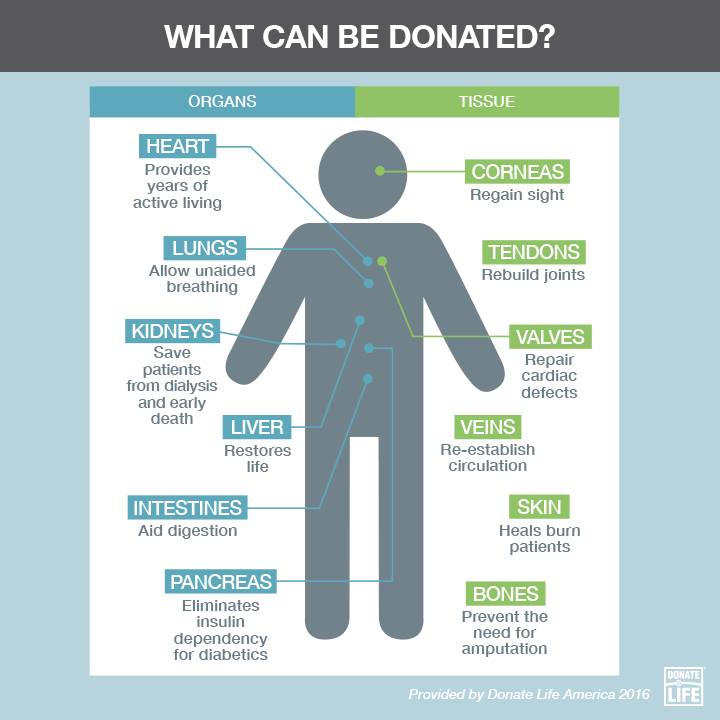
The most commonly transplanted organs are the kidneys, liver, heart, and lungs. In recent years, success has been achieved in curing diabetes with a pancreas transplant or extracting and transplanting islet cells from the pancreas that produce insulin.
Although only a small number of intestinal transplants have been performed, this treatment holds great hope for patients whose intestines have been severely damaged through illness, trauma or birth defects. Sometimes the stomach is also recovered and transplanted at the same time. Commonly recovered and transplanted tissues enhance the lives of many who suffer from traumatic injury or disease:
- Skin is used as a temporary dressing for burns, serious abrasions and other exposed areas.
- Bone is used in orthopedic surgery to facilitate healing of fractures or to prevent amputation.
- Heart valves are used to replace defective valves, often in children.
- Tendons are used to repair torn ligaments on knees or other joints.
- Veins are used in cardiac bypass surgery.
- Corneas can restore sight to the blind.
- Many tissues that cannot be used for transplant can be recovered and used in a variety of research studies to advance medical science.
What is a living donation, and why is it different?
Living donation is when a living person donates an organ or part of an organ to another person. The living donor may be a relative, friend, spouse, or an in-law. Or, the donor may be a stranger that has volunteered to help someone else. Living donation usually involves one of these organs: a segment of the liver, the lobe of one lung, a kidney, or a portion of the pancreas. Living donation is an alternative for individuals awaiting organ transplantation from a deceased donor. Learn more about living donation.
How can I list what organs and tissues I have decided to donate?
Donated organs and tissues may be used for the purpose of transplantation, research, education or therapy. You cannot specify at the time you register at the Virginia DMV. That process simply puts the heart on your driver’s license and puts your general donation decision in the Virginia Donor Registry. The Uniform Anatomical Gift Act specifies that the Registry will give you the option to decide which organs and/or tissues will be used for each purpose. If you register your decision at DonateLifeVirginia.org, you can specify your donation.
If you have registered at the Virginia DMV, you may update your registration to change your donation decisions.
How can my organs and tissues be used for research?
Organs and tissues that are not recovered for transplant may be used for medical research if the donor or family authorizes it. Non-transplantable organs and tissues help researchers every day find new ways to treat disease. A gift of organs and tissues for research can affect untold numbers of patients who benefit from the medical advances that result from their use in the laboratory. Virtually every disease that plagues mankind is being studied today with the help of donated human organs and tissues that cannot be transplanted.
If I donate my entire body to science, can I still be an organ, eye and tissue donor?
Not at this time. Currently, a body that is donated for scientific research under the Virginia State Anatomical Program cannot be used for organ, eye and tissue donation, except in the case of corneas. However, you should still register your decision to be an organ, tissue and eye donor in the Virginia Donor Registry in case your body is not accepted in the state’s anatomical program. Your family can also ask the recovery agency at the time of donation if there may be other whole body donation options after organ, eye and tissue donation has occurred. Organizations that offer those kinds of services must be approved by Donate Life Virginia or their activity is illegal in the Commonwealth.
If there is not an organ match when I die, can the surgeon take my organs and store them until they find a match?
No. If a match cannot be found for your organs, then they are not removed from your body. Your internal organs can only be outside of the body for a short amount of time, and there is no way to preserve them to be used later.
Your Family
If I donate my organs, will the recipients know who my family is?
The identity of all parties is kept confidential until both parties agree to release identifying information to the other. The donor family and the transplant recipient may receive such information as age, gender, and state of residence. Individually, the recipient may be told the circumstances of death, and the donor family may be informed of the transplants that were performed and receive feedback on how the health and lives of the recipients have improved. The organ, eye and tissue recovery agencies facilitate correspondence and meetings initiated by either the donor family or the recipient at any time, but only if both parties agree to it.
Will my family still have the final decision?
No. Your decision to be a donor will be honored. The Code of Virginia states that family permission is not required when you have documented your decision to donate. While it is still helpful for family members to know what you want, their permission will be sought only if your decision is not registered, either through the Virginia DMV or online at DonateLifeVirginia.org. Those under the age of 18 can indicate their wishes to donate, but parents and guardians by law must make that decision.
What about funeral arrangements?
There can be an open casket funeral, viewing or other standard memorial after donation. The donor is treated with utmost respect and dignity. The recovery of organs and tissues is conducted under standard, sterile conditions in an operating room, and the body is fully reconstructed once organs and tissues are removed. The family will make the funeral arrangements in the usual fashion. All funeral costs remain the responsibility of the family. Any costs that may be associated with donation are paid for by the organ, eye or tissue recovery agency.
Does my family have to pay for the donation?
No. Donation costs nothing for the donor or the donor’s family. While the family will receive a hospital bill for any lifesaving efforts that took place for their family loved one, if that patient dies and becomes a donor, all charges related to the donation process are billed to the organ, eye or tissue recovery agency.